
The “Apopka” Controller
The decision maker in the
iNetGrow system is the “Apopka” controller.
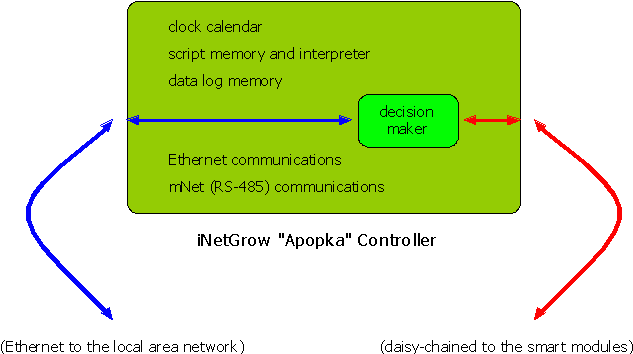
Network Connectivity
The controller has an Ethernet connection
to communicate over a local area network (LAN) using Internet protocols. It also connects to the mNet RS-485
network to communicate with the smart modules.
The use of Internet protocols
significantly enhances the effectiveness of the iNetGrow system. For instance, you may generate an
e-mail message based on a condition (say, when temperature drops below a
limit). You may then receive the
e-mail on your cell phone.
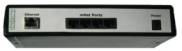
The back view of the Apopka
controller shows the Ethernet port (far left), the four mNet ports (each port
can support up to four daisy-chained modules), and the socket for the
transformer power plug (far right).
Timekeeping
The controller has a real-time
clock and calendar. Timekeeping is
necessary to perform periodical operations. These may be user-programmed tasks, or periodic data logging
activitirs.
Memory
The controller has
battery-backed (non-volatile) application memory. The memory is used to log data on the controller, as well as
to keep a script of automated tasks.
Interpreter
A general-purpose scripting
language is provided to describe the automated tasks to be performed by the
controller. Downloading this
script programs the controller to perform the automated tasks.
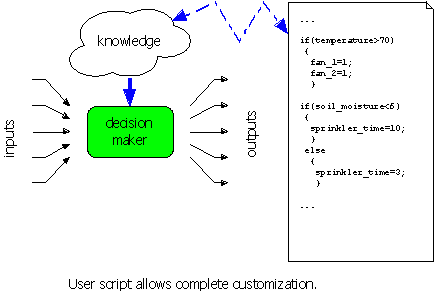
The script language of iNetGrow
is a general-purpose JAVA-like language.
This provides the maximum flexibility in implementing the automated
tasks for a given application. In
this sense, the iNetGrow controller is more like a PC or industrial
programmable logic controller (PLC) than most agricultural controllers. It allows you to implement your own
logic – even your own “trade secrets.”
The iNetGrow controller is truly
programmable. This allows custom
and proprietary control schemes to be implemented. In this respect, the iNetGrow system executes your
instructions, rather than force you to conform to the built-in logic of the
controller. The script is a series
of instructions that relate ultimately set the outputs depending on the
inputs. Various intermediate
variables may be used. In
addition, iNetGrow allows parameters that are stored in battery-backed memory
to be used in the script. These
parameters may store set points, schedules, operating modes, etc. Being in battery-backed memory, that
these values are preserved even if the power is lost. Refer to the section “Programming”
for more information.
Unlike the iNetGrow controller,
most agricultural controllers are really only “configurable.” Note that, although called
“programmable,” in such systems, one can perhaps change the parameters
involved, but not the operating logic.
Also see Data Logging, Programming, Programming
Examples, Script
Syntax
1.
What is Agricultural Control?
4.
Ethernet and Internet Protocols
5.
Pictures of Sample Implementations

© Rigel Corporation iNetGrow 2003-2006. All rights reserved.